
Friends in need: How to help effectively
Your friend cancels again. He replies briefly to messages, at the last get-together he barely ate anything, and whenever money comes up, he quickly changes the subject. You wonder whether to ask or leave him be. Maybe you've already written: "Let me know if you need anything," and haven't heard back since.
Friends in need don't automatically need more advice. They need help that fits their situation. That could be a calm conversation, support at the next appointment with an authority, or going together to contact a specialist service. What matters is taking the burden seriously without jumping to a diagnosis or taking over control.
Table of contents
- When friends get into trouble – How to recognise it
- Finding the right kind of help – A decision guide
- Financial support – Helping in a reputable and verifiable way
- Local and digital support services – What's available in Germany
- Common mistakes when helping and how to avoid them
- Sustainable support – Beyond the acute emergency
When friends get into trouble – How to recognise it
Suppose a friend withdraws and turns down invitations. Your first instinct might be to cheer him up: go out, meet people, get his mind off things. But if he lacks the money for the trip or barely has the strength for a conversation right now, this suggestion doesn't fit his problem.
So start with an observation instead of an explanation. "You've cancelled the last few get-togethers and seem pretty exhausted right now. How are you doing?" leaves room for a response. "You really need to get out and see people again," on the other hand, already assumes you know the cause and the solution.
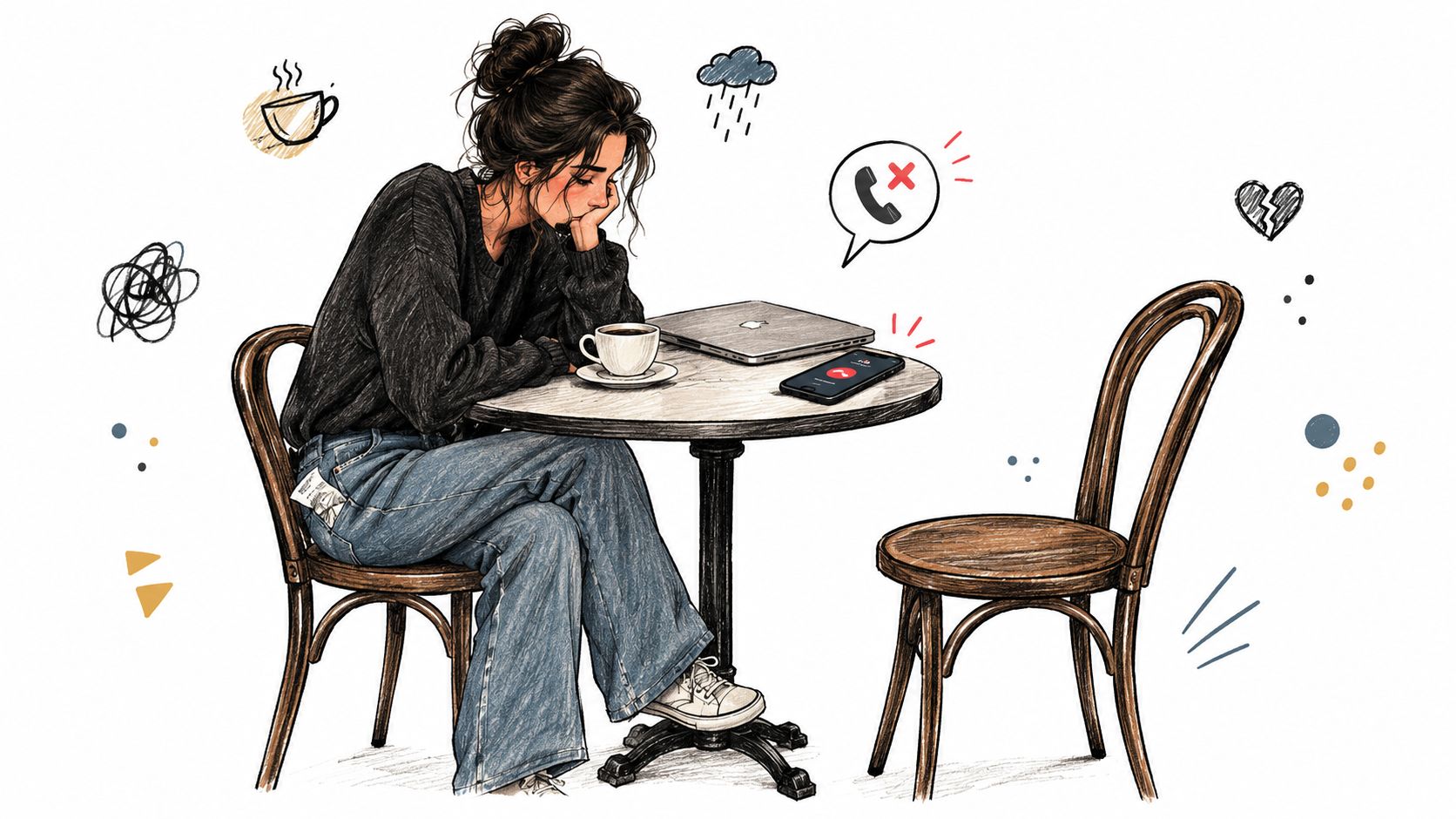
Noticing changes without judging them
A cancelled plan alone isn't a sign of a crisis. Pay attention to what has changed compared to usual behaviour, and ask rather than drawing a diagnosis from isolated signs.
- Emotional withdrawal: Your friend seems down, irritable or unusually quiet. Ask what's on his mind without immediately offering solutions.
- Difficulties in everyday life: Mail piles up, appointments are avoided, or necessary errands are put off. Clarify what exactly is causing this.
- Broken-off contact: Invitations are repeatedly turned down. Offer contact that requires neither money nor much energy.
- Threatening statements: Comments about self-harm, suicide or experienced violence require directly clarifying his safety.
Not every form of loneliness looks the same. The 2025 analysis by the Bundesinstitut für Bevölkerungsforschung on emotional and social loneliness among 18- to 53-year-olds distinguishes between different forms and emphasises the importance of targeted social support. Having many contacts is therefore not sufficient reason to dismiss expressed loneliness.
Asking can be gentle and specific
A conversation doesn't have to reveal everything right away. You can offer to listen during a walk, to eat together, or to call again later. What matters is that your friend is also allowed to decline without having to justify it to your friendship.
To start the conversation: Describe what you've noticed. Ask what's hard right now. Let the answer stand before suggesting anything.
If there is no response, you can reach out again without making accusations. A message like “You don't need to explain anything right now, I'm thinking of you” keeps contact open. If there are concrete signs of danger, however, waiting is not the right response.
Finding the Right Kind of Help – A Decision Guide
First check safety, then the need for support. The question is not how much you should do as a friend, but what this situation requires. Listening, practical help, and professional support can complement one another, but they do not replace each other arbitrarily.
First ask whether your friend is currently safe. If there are signs of suicidal risk, you may ask directly whether they are thinking about taking their own life, and whether they have already made preparations. Do not try to dismiss such statements as mere exaggeration.
In Acute Danger, Referral Matters Most
In cases of immediate self-endangerment, serious violence, or a medical emergency, you need the emergency medical service or the police. If possible, stay with the person, as long as you are not putting yourself in danger, and get support. In a threatening situation from a distance, you should tell the emergency responders what you know and where your friend is likely to be.
Do not promise to keep an acute danger secret. You can explain respectfully that you are bringing in help because you cannot take responsibility for the situation alone. A long conversation about possible causes must not delay necessary immediate help.
The overview helps with orientation. Acute danger always belongs in professional hands, even if longer-term support remains necessary afterward.
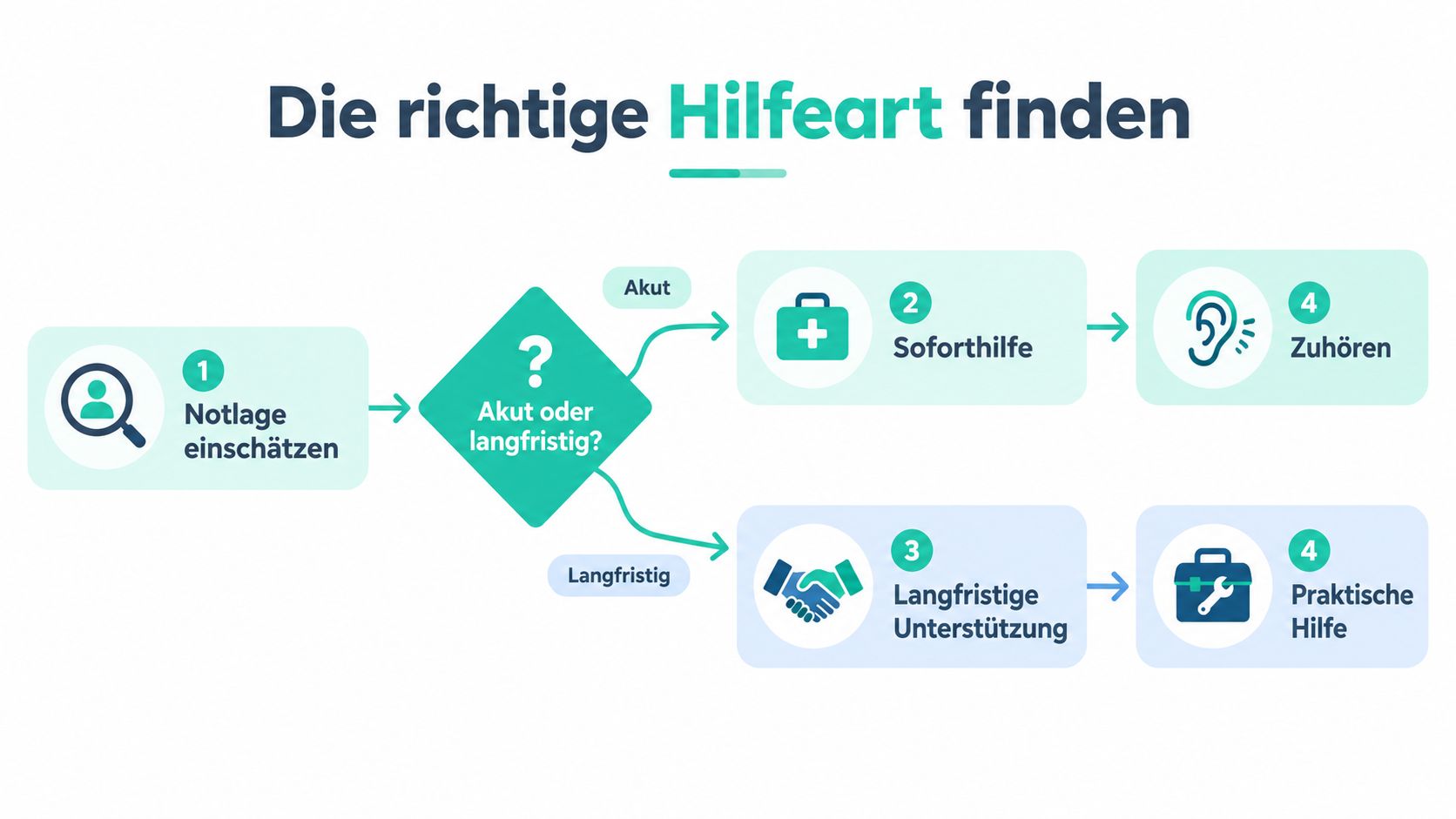
Determining the Bottleneck Without Immediate Danger
If your friend is safe, a simple question helps: “What is hardest to deal with right now?” Listen to the answer before choosing a type of help.
| Need | Appropriate support | Limit of friend support |
|---|---|---|
| Talking things through and being understood | Listening, asking questions, not judging feelings | Do not make a diagnosis or replace treatment |
| Handling a specific task | Sorting documents, accompanying, shopping | Do not take over decisions without being asked |
| Clarifying ongoing strain professionally | Making it easier to contact counseling or medical care | Do not take on the role of a professional yourself |
If someone wants to talk, ask whether they want listening or to think things through together. For an everyday problem, a limited offer is usually clearer than promising to “sort everything out.” For example, you could offer to read a letter together without immediately taking over all further steps.
You don't have to frame professional support as handing someone off. “I'll stay by your side and would like to help you find someone who knows about this” combines closeness with a clear boundary. Friendship can make access to help easier, it doesn't have to provide every kind of help itself.
Financial Support – Helping Responsibly and Transparently
Giving money can be the right thing to do. But it can also create expectations that were never discussed beforehand. So before transferring money, clarify whether you are giving it as a gift, lending it, or covering it for a specific purpose.
You should only give a gift in an amount you can afford yourself. A loan needs clear agreements about repayment and how to handle delays. If you secretly expect your friend to make certain decisions afterward, that is not unconditional support.
Separating Personal Trust and Financial Clarity
Paying a bill directly can make sense if your friend wants that. But it is not automatically more respectful than a money transfer. Anyone who wants to control every purchase is intruding significantly on the other person's self-determination.
Public donation campaigns are subject to different requirements than a private gift. There, people are meant to give money who don't personally know those involved. Accordingly, the purpose, accountability, and use of funds must be verifiable.
Donation Benchmarks Germany 2024
| Metric | Value |
|---|---|
| Doubts about transparency and effectiveness as the most important barrier among non-donors | 55% |
| Share of the population that donated | About 50.2% |
| Average annual donation | 174 euros |
This information on transparency and donation behavior is cited by the DZI article on donation trends and the importance of trust. It serves as guidance for designing donation appeals, not as a standard for how much an individual person should give.
Checking a Campaign for Transparency
Before you collect or donate, don't just examine the emotional story. What matters is whether those responsible can answer practical questions.
- Check the organisation: Are the responsible people, the statutes and, if applicable, a current tax-exemption certificate verifiable?
- Define the need: What is the money being collected for, for what period, and what happens if circumstances change?
- Explain the budget: Is there a clear distinction between direct aid, organisational costs and reserves?
- Agree on proof: How are payouts and progress documented without publicly exposing those affected?
The guidance on donating to social projects helps translate personal willingness to help into a comprehensible funding purpose. A good appeal also explains what is still open, instead of pretending certainty.
If you're collecting money among friends, keep a simple overview of income, expenses and remaining funds. Published updates don't need bank statements with private details. Accountability for money is necessary, public insight into private life is not.
Local and digital support services – What's available in Germany
The right point of contact isn't necessarily the best-known one. What matters is responsibility, accessibility and whether your friend can actually use the service. A link to a counselling centre doesn't help much if the energy to fill out a contact form is simply not there right now.
Depending on the issue, local points of contact can include social welfare offices, counselling centres run by Caritas or Diakonie, food banks and regional crisis services. Check the current requirements and services in each case. You shouldn't promise immediate appointments, free services or constant availability without checking first.
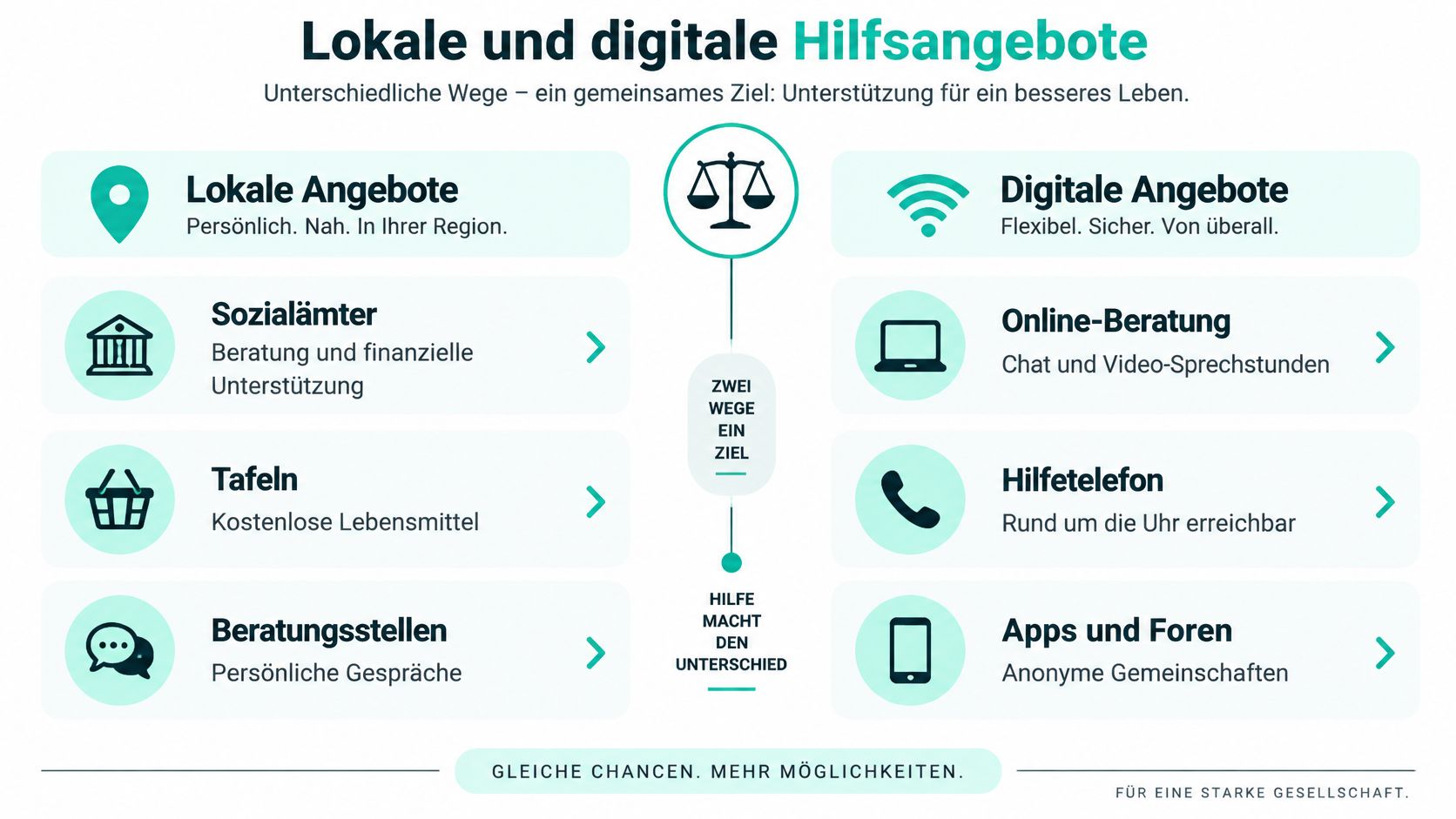
Weighing personal closeness against easy access
| Local contact fits better when … | Digital contact fits better when … |
|---|---|
| Documents need to be reviewed together | A written inquiry feels easier at first |
| Support accompanying an appointment is wanted | Travel or mobility is a hurdle |
| Support needs to be organised on site | Responsibility and process need to be clarified first |
Digital counselling is not the same as a forum. Check who is responsible for the service, what qualifications are stated, and how personal information is handled. Exchanging experiences with other affected people can be a helpful addition, but it shouldn't replace professional counselling.
Financing, too, can be organised digitally while the actual help takes place locally. The representative 2025 survey on donation behaviour in Germany estimates the donation volume at 14.06 billion euros, almost 13 percent more than in 2023. However, this doesn't tell you whether a particular local project covers your friend's actual need.
Referring without exposing private hardship
A referral works better when the next step is manageable. Instead of sending a long list, you can choose a suitable service together and formulate a short inquiry. Your friend decides what personal information goes into it.
- Get consent: Before making contact, ask what you're allowed to share.
- Share only what's necessary: A brief description of the issue is often enough for the first inquiry.
- Name responsibility: Clarify who will follow up on a response and whether support is wanted.
- Check organisations: Use the criteria for verified donation organisations before recommending a campaign.
A mosque community or a neighbourhood project can also be a suitable contact if it matches the wishes of the person concerned. However, religious affiliation is not a blanket consent to make financial or health problems known within the community. Closeness is helpful, but confidentiality is still required.
Common mistakes when helping and how to avoid them
"If I'm really a good friend, I have to manage this on my own." This expectation sounds loyal, but it leads to the wrong division of roles. You are a friend, not the entire provision, financing and crisis support for another person.
Help also becomes problematic when you decide more about the next step than the person affected does. Arranging an appointment without being asked, informing relatives without discussing it first, or publicly collecting money may be well-meant. But without acute danger, the desire to help shouldn't replace consent.

Don't mistake help for control
Unsolicited advice is especially tempting when you've handled a similar situation yourself. Still, your solution doesn't have to fit. It's better to ask what has already been tried and where a further attempt is currently failing.
You're allowed to be disappointed if a suggestion is rejected. But your friend doesn't owe you agreement in return for your willingness to help.
Expecting visible gratitude is also a poor basis for helping. Anyone offering support should first check whether they can handle a rejection or a different solution. Otherwise, an offer of help can quickly turn into an argument about how someone should behave.
Stating your own limits clearly
Boundaries are useful when they clarify something. “This is all becoming too much for me” describes your burden, but leaves open what will be possible going forward. Instead, say which task you can take on and what you will not be able to do.
- Don't promise constant availability: Agree on reachable contact times instead of implying you're available at any moment.
- Don't conceal financial risks: Don't lend anything whose loss would endanger your own livelihood.
- Don't play the expert role: Don't endlessly research diagnoses yourself when professional assessment is needed.
- Don't create group dynamics: Only distribute tasks with consent, and don't pass on private details unnecessarily.
If the situation occupies you for a long time, you can seek counselling yourself. Describe as sparingly as possible what support you need, instead of passing on your friend's entire life story.
Withdrawing without explanation is just as unhelpful as a promise you cannot keep. Limited, reliable support is more honest than boundless promises. You can hand off a task and still stay connected.
Sustainable support – Beyond the acute emergency
After the urgent appointment or the paid bill, not everything is automatically settled. So don't just ask whether the immediate task is complete, but also what comes next. The standard should be whether your friend can decide and manage things on their own again.
This doesn't require comprehensive care from the circle of friends. A manageable plan is enough: What does your friend want to achieve, what support do they want for it, and when will you look at it together? Only note down what actually helps you coordinate.
Measuring progress in daily life
Meaningful progress doesn't have to look spectacular. Perhaps your friend opens their own mail again, has reached the right counselling service, or keeps an appointment they chose themselves. What matters is their own assessment, not whether you feel confirmed as a helpful person.
| Shared question | What you can base the support on |
|---|---|
| What would you like to take on yourself again? | Hand tasks back step by step |
| What is still difficult? | Keep support targeted where it's needed |
| What no longer fits? | Change or end agreements |
| Who will be responsible going forward? | Clarify transitions explicitly |
Shared time shouldn't become entirely a helping session. A walk can simply remain a walk. Your friend shouldn't have to report on progress at every meeting just to keep being invited.
Turning personal help into reliable structures
If you want to provide support beyond an individual case, you can regularly fund a local initiative. Recurring Sadaka should fit your own budget and be tied to an understandable project. The explanation of the meaning of Sadaqah Jariyah offers a starting point for thinking about longer-term benefit.
For longer-term support: Don't just check whether help is still needed. Also check whether your previous form of help still fits.
For a funded project, different questions make sense than in a private conversation: Are the promised activities being carried out, are changes explained, and are open difficulties named? Ask for comprehensible information, but not public photos proving personal hardship.
Effectively supporting friends in need means neither looking away nor taking everything upon yourself. Closeness, concrete relief, and professional responsibility each have their place. If you keep these tasks separate, you can help reliably while respecting your friend's independence.
At SadakaNow you can support verified projects run by mosques, aid organisations, and social initiatives with Sadaka and follow their published progress. If you'd like to complement personal help for friends in need with a social project, visit the platform and check the purpose, the organisation, and current project updates before you donate.