
Crowdfunding for Associations: The Complete Guide 2026
Anyone who sits on the board of an association knows this situation: the project makes sense, the members support it, but the association's account lacks the money for implementation. Perhaps a youth team is supposed to get new equipment, a cultural association wants to finance a performance, or a mosque congregation wants to make its rooms more accessible. The sentence quickly comes up: "Let's just start a crowdfunding campaign."
It's not quite that simple. Crowdfunding for associations doesn't work automatically just because a campaign is online. What matters is the legal classification, a solid own network of contacts, a concrete project, and a payment process that cleanly separates donations, considerations, and receipts. Anyone who clarifies these basics can use crowdfunding as an effective financing instrument. Anyone who skips them risks queries from supporters, problems with donation receipts, and a disappointing campaign result.
Table of Contents
- Why crowdfunding for associations is more than choosing a platform
- Donation, reward, or profit-participation rights: the four models for associations
- Creating the legal requirements for tax-exempt status
- Planning and preparing the campaign step by step
- Platforms compared and where SadakaNow fits in
- Setting up payment processing, transparency, and ongoing campaigns
- The 14-day plan for the first association campaign
Why crowdfunding for associations is more than choosing a platform
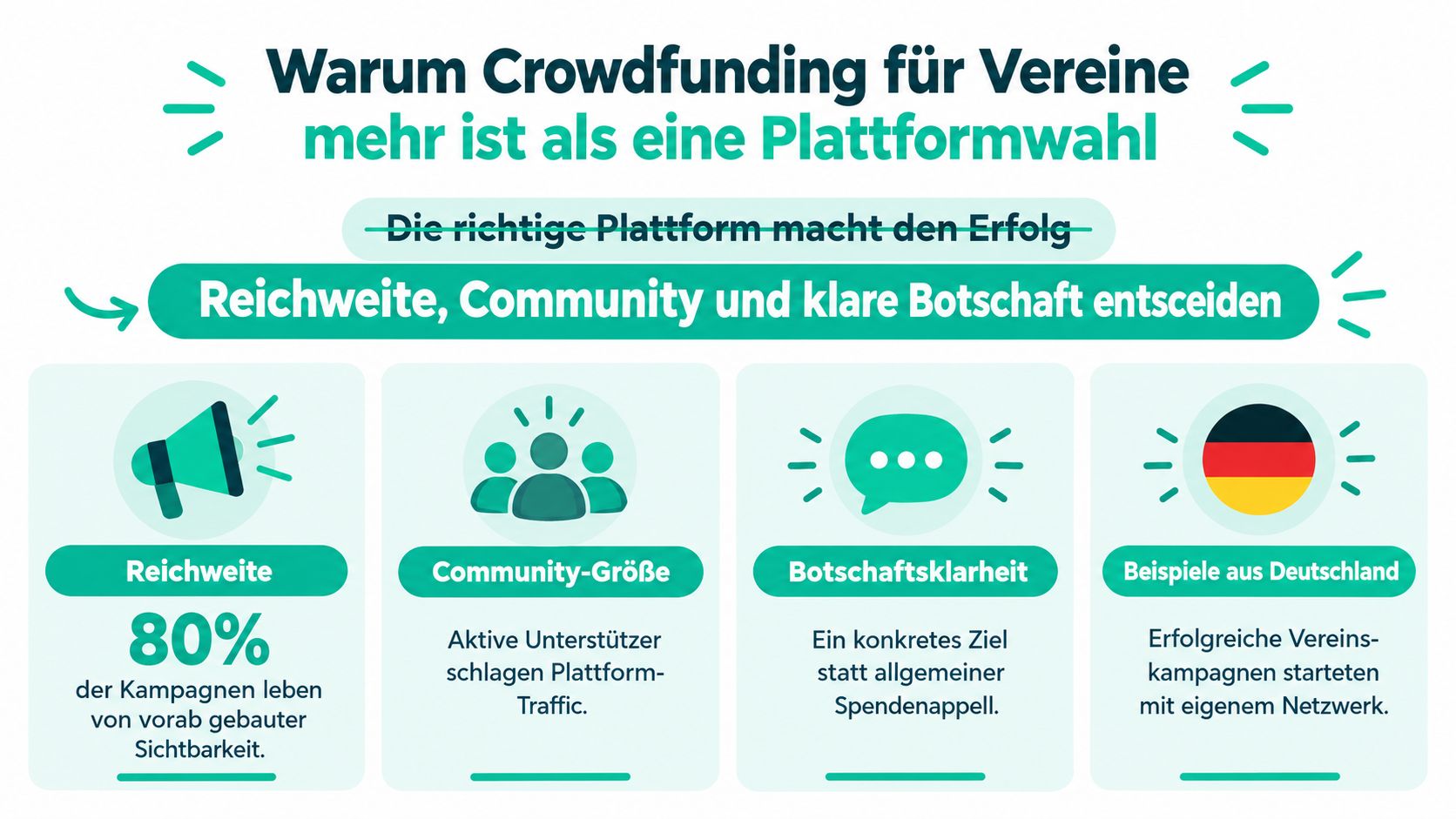
A board compares Startnext, Betterplace, and GoFundMe, chooses the best-known platform, and finds after four weeks that hardly any new supporters have been added. The mistake isn't automatically with the platform. Reach comes first from an approachable community, a clear request, and a project whose benefit is immediately understandable.
The platform mainly takes on technical tasks. It can bundle payments, build trust, and structure the process. However, it doesn't bring an association members, parents, former active participants, local businesses, or media contacts. That's why the platform comparison should only begin once the association's own network, the funding goal, and the legal classification have been established. Whether a payment counts as a donation or is tied to a consideration also determines which communication and which proof of receipt are permissible.
The historical overview of the crowdfunding survey shows that smaller and medium-sized projects in Germany were generally financeable. In the first systematic German crowdfunding survey from 2011, 125 projects on six German-language platforms were examined. 67 projects were successful, 58 unsuccessful, and a total of 208,000 euros flowed through crowdfunding. The success rate was 53 percent. Successful projects received an average of 2,943 euros against an average target value of 2,719 euros.
The three levers before the launch
Your own reach: Inform the most important supporters before the launch. A campaign that only becomes known on the day of publication gives away its initial momentum.
Clarity of message: "Support our association" isn't enough. "We're financing a mobile ramp for the association's premises" names both the problem and the goal. In just a few sentences, supporters need to understand what the money will be used for and how the association will report on it.
Credible impact: Photos, a cost plan, a timeframe, and regular updates make the project verifiable. Emotions help, but they don't replace verifiable information.
The Fraunhofer analysis on crowdfunding during COVID-19 recorded 1,880 campaigns, which together raised more than 12.76 million euros by mid-August 2020. The success rate across all initiator groups was more than 86 percent, and for companies and associations even over 90 percent. These figures are no promise for every association campaign. They show how strongly the occasion, urgency and reachable target group influence the outcome.
Reality check: If the association lacks its own distribution channels and a clearly defined project, it should first build relationships, funding applications or local partnerships. Choosing a platform does not solve this problem.
Donation, reward or profit-participation rights: the four models for associations
The term crowdfunding does not describe a single legal form. For an association, the first decisive factor is whether supporters receive something in return. A voluntary payment without a return can be a donation. A T-shirt, a ticket, a named acknowledgement or another thank-you gift, on the other hand, can constitute a paid service. This distinction affects bookkeeping, VAT and the question of whether a donation receipt may be issued.
Four models with different consequences
| Model | Legal nature | Suitable for associations? | Tax consequence |
|---|---|---|---|
| Classic donation | Voluntary payment without a return | Yes, especially for charitable projects | Use of funds in accordance with the statutes and proper documentation |
| Reward-based crowdfunding | Payment with an agreed return | Yes, with a clear distinction | The return can trigger a fee and economic activity |
| Profit-participation rights (Genussrecht) | Financial participation with an asset-related character | Generally unsuitable for non-material association projects | Legal and tax review required before any use |
| Pre-financing or in-kind donation | Support through advance payment or a specific in-kind contribution | Yes, if purpose, value and service are clearly documented | Classification depends on the return, valuation and accounting treatment |
With the donation model, the supporting person receives no economic return. A thank-you contribution, a public acknowledgement or a symbolic report does not automatically change the classification. However, as soon as the association promises a concrete benefit, the arrangement must be reviewed. The Verbraucherzentrale points out that supporters generally have no say in crowdfunding and that it should be clarified in advance what happens if the project fails. The bpb's introduction to crowdfunding also notes that many crowdfunding campaigns fail.
Reward-based crowdfunding suits projects where the association can actually deliver something. A cultural association might, for example, offer tickets or a programme booklet. A sports club might provide a small token of thanks. However, the service must not merely be labelled a "thank-you" in words if it has a relevant economic value. In that case, the accounting and tax treatment must be reviewed differently than for a donation.
Profit-participation rights are not a straightforward alternative for classic non-material association projects. They presuppose an economically oriented participation logic and have no place in a campaign that is merely meant to finance a charitable project. Without specialised legal advice, an association should not use this model.
With pre-financing and in-kind donations, the association must record what is being delivered, what purpose it serves and how the value is documented. A sports club collecting money for a new training area without offering anything in return typically remains within the donation model. A cultural association that bindingly promises an event ticket for a payment must take the return into account.
The decision framework
Answer four questions before launching the campaign:
- Does the association pursue a recognised charitable, benevolent or ecclesiastical purpose with the project?
- Is there a return that goes beyond a purely symbolic thank-you?
- Is the support one-off, or does it create an ongoing obligation to perform?
- Do supporters need a donation receipt?
For most charitable associations, a pure donation campaign without any return is the clearest option. Have the campaign page, the thank-you gifts and the receipt logic reviewed by tax advisors before launch. An additional overview of purpose-bound donation communication can be found in the article on donating during Ramadan.
Creating the legal requirements for charitable status
A campaign should only go live once the association has all its evidence fully at hand. Charitable status is not merely a wording choice on the campaign page. It rests on the statutes, tax status, actual management and a traceable use of funds.
The documents needed before launch
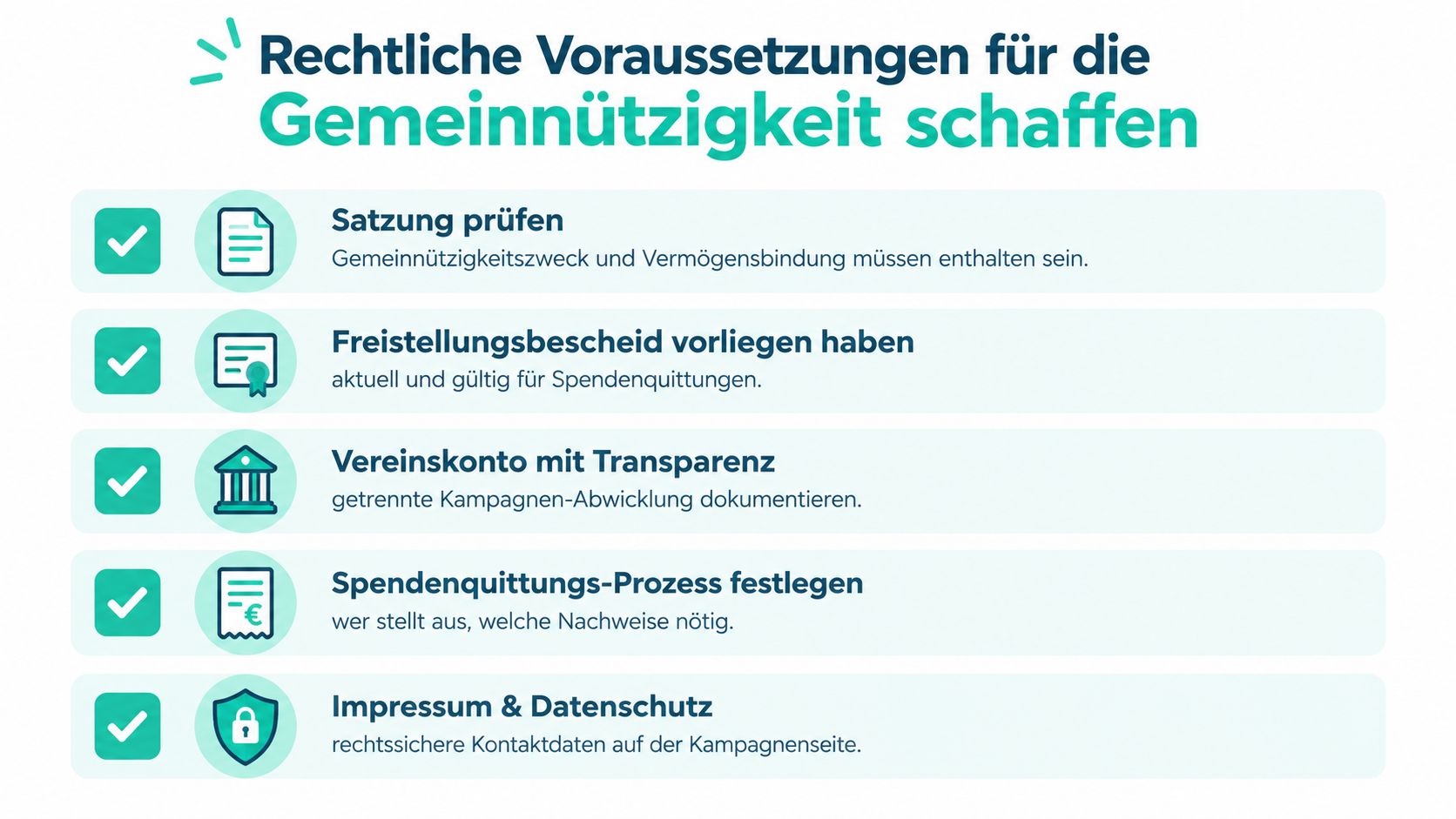
First check the articles of association. They should clearly state the non-profit, charitable, or ecclesiastical purpose and reflect the exclusive and direct pursuit of that purpose. The provision for the allocation of assets in case of dissolution must also be regulated. Economic activities do not automatically fall within the non-material sphere. The association must therefore distinguish whether it is collecting donations or operating a commercial business.
The certificate of exemption or another current proof from the tax office belongs in the campaign folder. If this proof is not yet available, a provisional certificate from the tax office may be relevant in individual cases. The association should not interpret this itself, but should clarify it with the tax office or a tax advisor.
Platforms typically require several documents. Depending on the provider, these include the extract from the register of associations, the articles of association, a copy of the tax assessment notice, proof of representation, and proof of identity of the board members authorized to represent the association. In addition, the association needs an account where incoming payments, fees, refunds, and payouts remain clearly traceable.
The 10-Point Checklist
- Check the purpose in the articles of association: The specific campaign project must match the purpose of the association.
- Check the allocation of assets: The provision for the case of dissolution must be included.
- Secure tax status: Have the certificate of exemption or an admissible substitute document ready.
- Prove authority to represent: Document responsibilities within the board in writing.
- Update the register of associations extract: The platform must be able to verify the acting persons.
- Establish the association account: Do not process campaign funds through private accounts.
- Formulate the purpose of the donation: Describe the purpose, goal, and use of funds clearly.
- Determine the receipt process: Establish responsibility, data requirements, and dispatch of donation receipts.
- Document the use of funds: Archive invoices, resolutions, and project progress in an organized manner.
- Check data protection and legal notice: Verify contact details, privacy notices, and responsibilities on the campaign page.
The funds may only be used within the framework of the articles of association. The association therefore needs a board resolution on the project, a budget plan, and a filing system for invoices. Anyone who only organizes the use of funds after the campaign ends makes their own accountability more difficult and creates avoidable follow-up questions.
Planning and Preparing a Campaign Step by Step
A viable campaign begins with a clear board decision: What should be financed, why is the project necessary now, and how will supporters recognize the impact? Every board member must be able to give the answer in one sentence. Only after that come the platform, image material, and publication.
Goal, Minimum Amount, and Story
Determine the actual project costs and divide them into understandable cost blocks. Also set a minimum threshold above which implementation remains sensible. In the all-or-nothing model, this minimum goal must be calculated especially realistically. As already shown in the Fraunhofer evaluation, such campaigns do not automatically perform successfully. The evaluation also shows that a clear occasion can strongly shape the course of a campaign. For associations, what matters most is therefore whether their own community understands the project and actively spreads it further.
Choosing a platform does not replace reach. Before starting, check how many members, supporters, relatives, and local partners are actually reachable. A small association with personal outreach can start better than a larger association without a fixed distribution list.
The story follows a simple sequence:
- Problem: What is specifically missing today?
- Solution: What does the association buy, build, or enable?
- Impact: What changes after the funding?
Avoid dramatized promises. An authentic photo from everyday association life, a short quote from a person involved, and an open cost plan build more trust than an overproduced advertising message.
The Workflow
Plan the preparation as its own project and clearly separate it from the later campaign period. The briefing should include budget, texts, image material, legal review, payment method, and distribution list. The pre-launch begins as soon as the first members, partners, and multipliers have been personally informed.
A practical Kanban workflow includes:
- Briefing: The board decides on the purpose, goal, minimum amount, and responsibility.
- Production: One person writes, a second checks facts, a third collects images and documentation.
- Legal review: Donations, considerations, donation receipts, data protection, and tax status are assessed separately.
- Building reach: Members receive prepared messages, local media a short press kit.
- Launch: A designated person answers questions and publishes regular updates.
- Evaluation: Incoming payments, the origin of support, and open questions are reviewed regularly.
To address your own supporters, you need clear roles, binding response times, and a shared editorial plan. The Community Management Best Practices provide useful guidance for this.
Campaign metrics for associations at a glance
| Metric | Calculation | Example value |
|---|---|---|
| Target amount | Project cost plan | Derived from quotes and board resolution |
| Average support amount | Expected total divided by number of supporters | Estimated using previous donation or member data |
| Required reach | Required number of supporters divided by realistic conversion rate | Test in advance with your own distribution list |
| Minimum amount | Amount from which implementation makes sense | Decided as a binding lower limit |
| Launch date | Preparation completed plus advance communication | Set only after payment and receipt testing |
The crowdfunding brochure of the state of Schleswig-Holstein reports that for successful projects in 2020, the average target amount was just over 9,500 euros, with around 120 supporters, about 65 euros per contribution, and a success rate of 56 percent. Use these figures as guidance, not as an automatic benchmark. A local association with an engaged niche community plans differently than a nationwide organisation. What matters most is your own reliable reach.
Comparing platforms and where SadakaNow fits in
The choice of platform should be based on suitability, not popularity. Check fees, payout, legal jurisdiction, data protection, payment methods, ongoing campaigns, and how donation receipts are handled. A platform with high visibility is of little use if it represents rewards incorrectly or does not document payouts transparently for the association.
| Platform | Fee model | Payout | Suitability for associations |
|---|---|---|---|
| Classic donation platform | Platform and payment fees depending on the provider | According to the provider's terms | Suitable for pure donations, if proof and earmarking requirements fit |
| Reward platform | Fees may be linked to payment processing | According to campaign or payout rules | Suitable for projects with clear rewards |
| Direct solution | Payment provider and administrative costs managed independently | Directly or via the payment service provider used | Suitable for associations with their own infrastructure and accounting routines |
| SadakaNow | 0 percent platform fee, voluntary tips as funding model | According to platform process, with several payment methods | For vetted, sadaqa-oriented, and Islamic association projects |
SadakaNow is a German donation platform for vetted projects run by mosque associations, aid organisations, and social initiatives. The platform operates with a 0 percent platform fee, an optional tip feature, and payments via SEPA, PayPal, and credit card. Associations can add goals, descriptions, images, and updates for their campaigns. The platform verifies charitable status before activation.
This does not suit every association. A cultural association that wants to sell tickets or products as a reward needs a solution that properly supports this kind of paid structure. An Islamic community that wants to organise a purpose-bound Sadaqa campaign with a transparent project page and regular updates, on the other hand, will find a more fitting thematic framework here. A factual overview of other providers can be found in the article on crowdfunding platforms in Germany.
Before deciding, also compare the articles from Küstermann Media GmbH on digital communication and online marketing. The platform remains a tool. Reach, content, and responsibility must still lie with the association.
Setting up payment processing, transparency, and ongoing campaigns
The payment process must work before launch. Test not only whether a payment is possible, but also whether the association can clearly assign, document, and later evaluate it. Check the payment service provider, possible transaction costs, refunds, payout deadlines, and what data is needed for proof.
Three payment methods
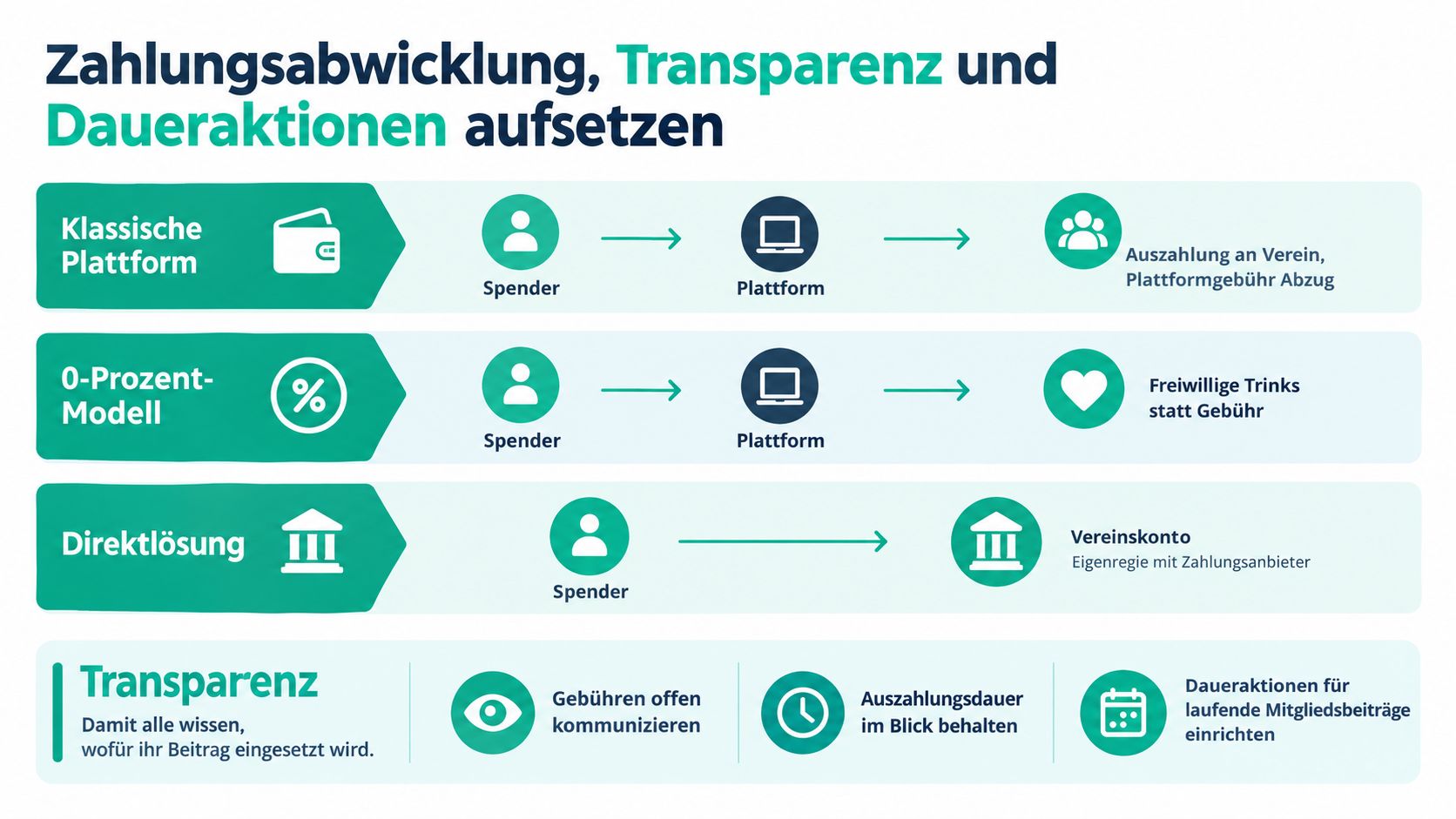
With a classic platform, the supporting person pays the platform. The platform deducts agreed costs and transfers the remaining amount to the association. With the 0-percent model, the platform fee is not deducted from the donation amount. Instead, the platform can fund itself through voluntary tips, voluntary donation shares, or optional services.
A direct solution routes the payment to the association's account or through a payment provider managed by the association itself. This gives the association more control, but also increases responsibility for data protection, inquiries, reconciliation, and accounting. Stripe or PayPal can handle technical payment functions, but their costs and contract terms must be reviewed separately.
The receipt process
Before you start, define what data the donor must voluntarily provide if they want a donation receipt. The association should document payment, date, purpose, name and address according to the applicable requirements. The records must be protected against subsequent alteration and must be traceable for accounting purposes.
Communicate clearly whether a payment counts as a donation. In the case of a consideration in return, the association must not simply issue a donation receipt. The tax treatment of fees and possible reports to the tax office should be coordinated between the association's accounting department and its tax advisor. Blanket statements about thresholds do not belong on a campaign page if the specific situation has not been checked.
From single campaign to ongoing initiative
A completed campaign should not end with the thank-you post. After the project is finished, offer voluntary monthly support, a sponsorship, or another earmarked donation. The new initiative must remain clearly separated from the original funding goal.
A solid process consists of four steps:
- Test payment: Check test payment, refund and payout.
- Organize data: Store payment reports, donor data and fees separately.
- Report progress: Regularly publish project status, expenses and open issues.
- Close quarterly: Reconcile income, use of funds and follow-up actions internally.
Transparency rule: Whoever asks for money should also show what happened to it. A short closing report with receipts and project photos builds more trust than another donation appeal without a result.
Associations can find further ideas for recurring earmarked support in the article on Spenden für Waisenkinder, without transferring its model to their own project unchecked.
The 14-day plan for the first association campaign
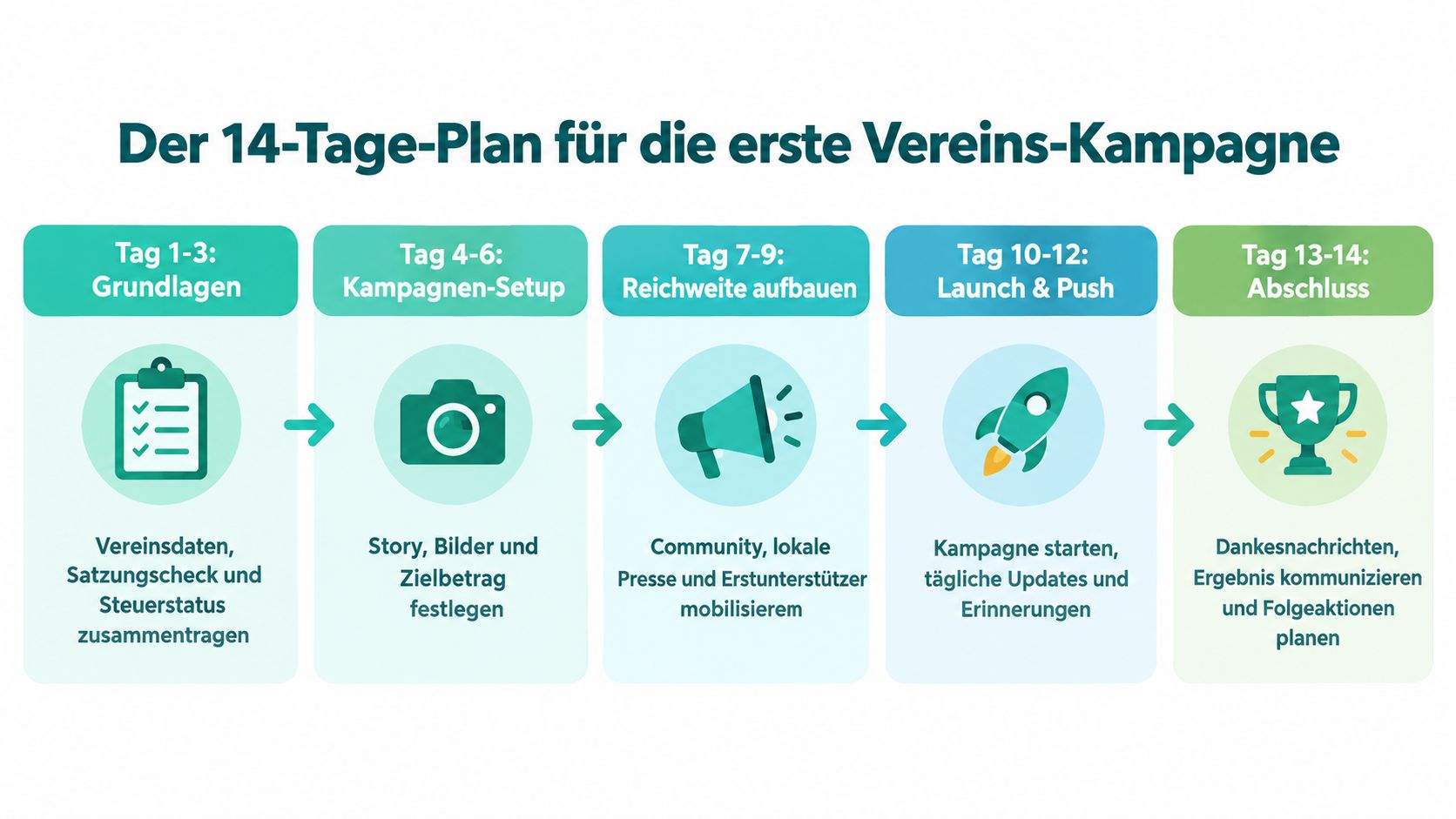
An association does not need complicated project management for its first launch. It needs a clear sequence and one person who follows up on decisions. The following fourteen days are enough to check the basics, prepare a campaign, and approach the launch in a controlled way. Actual production may take longer if images, resolutions, or tax documents are missing.
Day 1 to 3
Gather the association register extract, statutes, tax assessment, proof of representation, and account details. Check whether the project fits the statutory purpose and whether the chosen model involves a donation or a consideration in return.
Then create a shortlist of three platforms. Compare fees, payment methods, payout, data protection, and donation receipts. Cross out providers whose terms the association cannot explain clearly.
Day 4 to 6
Decide on the target amount, minimum amount, purpose, and responsibility. Write a story in three parts: the initial problem, the planned solution, and the expected impact.
Determine which form of thanks is permissible. If a consideration in return is planned, have its tax classification checked before publishing it on the campaign page.
Day 7 to 9
Test payment, payout, reversal, and data export. Clarify who processes donation receipts and what information is required for this.
Prepare members, partners, local media, and personal contacts. Give them not just the link, but also a short text, an image, and a clear request to share. Your own distribution list is more important than hoping for random platform visitors.
Day 10 to 11
Fill in the campaign page. Use a meaningful cover image, an understandable cost breakdown, a section on the use of funds, and an FAQ covering the goal, duration, payment, and failure.
Name a contact person. Questions about purpose, tax status, or repayment must not go unanswered.
Day 12 to 13
Send a personal advance notice to your most important supporters. Prepare thank-you messages, update texts, and templates for the receipt process. Also plan when progress will be published.
Day 14
Launch the campaign with a clear call to action and a reachable contact person. Check the response regularly. If there is hardly any reaction after 72 hours, do not immediately change the goal. First check the message, the distribution list, the images, and the direct donation path.
Warning signs include an unrealistic target amount, a missing story, no own distribution list, and unclear platform fees. Stop the launch if the association cannot explain whether a payment is a donation or a fee. A postponed campaign is more professional than a public false start.
Crowdfunding for associations should also not serve as a substitute for ongoing liquidity planning. Financing a recurring deficit, a lack of responsible people, or a project without a communicable benefit all argue against an immediate launch. For a clearly limited project with an engaged community, however, a campaign is a useful test: it checks not only willingness to pay, but also how well the association can explain its cause and make trust visible.
SadakaNow offers charitable, sadaqa-oriented associations verified campaign pages, multiple payment methods, transparent project updates, and a model with no platform fee and a voluntary tip option. If your association is preparing a concrete Islamic or social project, submit the documents and check the possibilities at SadakaNow.